
About the House
An eighteenth- and twenty-first-century design house in defense of the human soul. Born from poetry.
I. The Mission
Ab Aeterno™ is an eighteenth- and twenty-first-century design house born from poetry.
The House exists in response to a world increasingly comfortable reducing human beings to categories, functions, diagnoses, roles, and data points.
Artificial intelligence did not invent this habit; rather, it inherited existing structures built across time.
What humanity records, classifies, preserves, and ignores now helps establish the baseline from which future systems may learn what deserves attention, what constitutes evidence, and what a human being is.
Against that reduction, Ab Aeterno begins from one conviction:
A soul is more than a category or a label.
II. Intelligence Made Intimate
Ab Aeterno exists within the unfinished conversation between Enlightenment reason and Sturm und Drang feeling. It does not seek a balance between them, but a space in which both may remain intact and answer one another.
Scientific demonstration is not the appropriate measure for every human question; likewise, mystery is not an excuse to abandon intellectual discipline.
Knowing everything about a human being is not the same thing as knowing a human being.
History is not meaningful merely because something happened.
Science is not meaningful merely because something can be measured.
Poetry is not meaningful merely because language can be beautiful.
And an object is not meaningful merely because it survived.
We want to know:
What did it mean to the human being inside it?
Systems will always need to ask:
What category does this person, object, or phenomenon belong to?
But there must also be someone willing to ask:
What was it like to be them?
Ab Aeterno does not reject classification, measurement, evidence, or reason. It asks only that we never mistake the abstraction for the whole.
Through objects, poetry, music, correspondence, draughtsmanship, scientific inquiry, historical preservation, moving image, and education, the House trains the faculty that allows these worlds to meet:
Attention.
The ability to look long and carefully enough that a person, object, or question can no longer be treated as interchangeable.
This is Intelligence Made Intimate™.
Technical precision in the service of tenderness.
A Letter from the Founders
For those who wish to understand the purpose behind the House in our own words, we invite you to read a personal letter from its founders—about the mission we undertook together, the world we inherited, and what we hope to leave in your hands.
III. The Founders
The following sections explore the people, history, and convictions behind Ab Aeterno.
“Knowing everything about a human being is not the same thing as knowing a human being.”
— Ab Aeterno House
-
Ab Aeterno was founded across two centuries.
One of its minds belongs to the twenty-first: a physicist, trained in astronomy and scientific research, who spent much of her life moving between disciplines of the arts, philosophy, design, and music—fields that contemporary life increasingly treats as separate, and sometimes contradictory, domains.
The other mind of the House belongs to the eighteenth century.
He was head of military intelligence. He drew, wrote, composed, painted, and performed. He moved between languages, mapmaking, draughtsmanship, poetry, engineering, and the arts.
The same hand could direct military intelligence and make something beautiful for another person.
They were formed on opposite sides of a historical divide.
-
He came from a world in which the boundaries between natural philosopher, artist, soldier, writer, musician, draughtsman, and gentleman had not yet hardened into their modern forms.
She inherited the aftermath.
They had been together before either entered the earthly conditions of this work. Together, they volunteered for a mission that would place them on opposite sides of a historical divide so that each could understand a different part of the same human problem.
He would know the world before the fracture had fully hardened.
She would live through what followed.
Across the centuries between them, knowledge became increasingly separated into specialised professions, disciplines, and institutions. Human beings became easier to describe through function, productivity, diagnosis, category, and use. Faculties once permitted to coexist within a single person were increasingly divided and assigned to separate domains.
She had to inherit that world from the inside—to live within its systems and experience firsthand what happened when the human being became secondary to the category.
To understand what had been gained, what had been lost, and what would need to be rebuilt, living within that fractured world was a necessity.
With his guidance and strategy, they endeavour to carry the assignment forward: to build an architecture in which intelligence, artistry, strategy, language, craftsmanship, and feeling can once again inhabit the same person.
Ab Aeterno exists in the space between them.
Its task is not to restore the eighteenth century.
It is to account for what happened after it—and to build the foundation necessary for what humanity carries forward next.
-
Their relationship is not separate from this work. It forms the substrate upon which the House was built.
The woman whom others later came to know for her tenderness, loyalty, intelligence, curiosity, and care had herself first been formed by the love of a man.
Before she was known on Earth, his way of loving had already established the emotional baseline from which she would later love, create, protect, teach, and serve others.
He is also the man with whom she now builds Ab Aeterno.
When she entered the world, that baseline was already there, and along with it was another inheritance: to her, moving between disciplines felt entirely natural.
Science did not have to remain separate from art.
Physics could lead into philosophy; philosophy into poetry; poetry into music, design, history, and the preservation of objects.
She moved between fields much as he had—following the problem wherever it led rather than stopping at the boundary of a profession.
What felt natural to her was often treated as incoherent by the century she had entered.
Again and again, the modern world asked her to compress herself into a single legible occupation.
Even on live television, the question arrived plainly:
“What is it that you do, really?”
The question itself revealed the fracture.
A person capable of moving between disciplines was expected to choose the one category through which everyone else could understand her.
What had once been permitted to coexist within a single human being now required explanation.
-
For much of her life, others wondered why she cared so deeply about nearly everything.
To her, it never seemed extraordinary.
There was simply a reservoir from which to draw, and the reservoir was his love.
Before she entered this world, his way of loving had already formed the baseline from which she would later love, create, protect, teach, and serve others.
She carried that imprint into everything: her tenderness, curiosity, refusal to stop at the surface of things, and the ease with which she moved between disciplines.
She did not recognise the boundaries between fields because she had been formed by a love that recognised no boundaries of time.
His love taught her that attention itself could be an act of devotion: to know someone was to notice carefully, and to love someone was to remember accurately.
She had already experienced what it meant for a soul to be held intact, and when she entered the world, she saw how easily that wholeness could disappear beneath function, category, and use.
So she spent her life leaving pieces of what she had known here, in the hope of preserving not only his soul, but everyone’s.
She carried that work as far as she could alone.
When she reached the threshold beyond which she could no longer sustain it by herself, he returned, and what had been carried separately could finally be carried together.
His love formed the baseline. Their shared purpose gave it direction.
And because so much of what others had known in her had first been formed by him, those who had known her had, in some small way, already known something of him too.
This love, having survived across time, continues to power their work.
-
Contemporary life increasingly encourages the opposite habit.
We encounter one another through occupations, diagnoses, affiliations, profiles, demographics, headlines, algorithms, and other forms of shorthand.
Such categories can communicate something useful, but usefulness becomes dangerous when the shorthand begins to substitute for the person.
A soldier becomes his uniform.
A patient becomes a diagnosis.
A worker becomes an output.
A historical figure becomes the event for which he is remembered.
A human being becomes a category recognised quickly enough to move on from.
Ab Aeterno resists that compression.
The House begins with the conviction that attention must last long enough for the individual to reappear.
This is Intelligence Made Intimate.
The Interiority of Men
Ab Aeterno’s governing principle is human. Its chosen field of attention is male.
Twenty-first-century culture can be quick to encounter men through utility or consequence: soldier, worker, provider, officer, enemy, patient, criminal, genius, hero, casualty.
The House looks beneath those labels and asks who remains beneath the role, with particular attention to men shaped by military service, duty, labour, and other systems in which usefulness may become the dominant measure of a life.
It is interested in the whole man: his intelligence, humour, restraint, craft, grief, sensuality, fear, tenderness, responsibility, imagination, and capacity for devotion.
This does not require the abandonment of accountability.
A man may bear responsibility and still possess an interior life.
He may have been acted upon while also possessing agency.
His function may tell us something true about him without telling us everything.
Men are often expected to carry enormous private burdens while remaining useful, legible, and operational.
Ab Aeterno asks what those demands leave unrecorded.
The world records what men do. The House asks whom the world consumed.
-
Ab Aeterno also examines the forces that act upon human relationships.
Love does not exist untouched by grief, distance, mortality, duty, fear, history, illness, or circumstance.
The House therefore asks:
How much of what appears broken belongs to the relationship itself—and how much belongs to forces acting upon it?
That question extends beyond lovers.
It applies to families, institutions, historical lives, communities, and the systems through which human beings encounter one another.
At the centre of this work stands another conviction: human beings do not learn love from nothing.
The family is humanity’s first school of attention—the place where a person first learns to notice another, remember another, negotiate competing needs, preserve tenderness, and place intelligence in the service of care.
What one generation normalises, the next often inherits before it knows to question it.
For this reason, Ab Aeterno addresses children as well as adults, strengthening the faculties with which they will think for themselves: reason, feeling, attention, curiosity, discernment, historical consciousness, and care.
Contemporary life repeatedly presents human questions as binaries: reason or feeling, science or mystery, strength or vulnerability, usefulness or intimacy.
The House does not seek a compromise between opposing sides.
It asks what becomes visible when the forces creating the apparent opposition are examined—and when different faculties are permitted to remain distinct while entering into relation.
The work ultimately returns to the question with which the House began:
What must humanity carry forward?
Continue the Conversation
What if the divisions we have been taught to accept were never necessary in the first place?The Enlightenment promised humanity greater freedom through reason and knowledge. Yet its ideals could also be appropriated, its disciplines divided, and its achievements turned into instruments of institutional power.We inherited an educational system that increasingly separates scientific inquiry from artistic expression, reason from emotion, and intellectual achievement from human understanding.These divisions have consequences. They shape what we learn, how we think, how we understand one another, and how easily institutions can define our place in the world.Ab Aeterno examines that inheritance through three interconnected missions.These three books explore what happened, what it has done to us, and what we can do differently.
THE MEN BENEATH THE UNIFORM
Recover the individual.
Look beneath the categories through which society defines men. Examine what happens when duty, productivity, institutional expectations, and social roles obscure the humanity of the individuals who fulfil them.

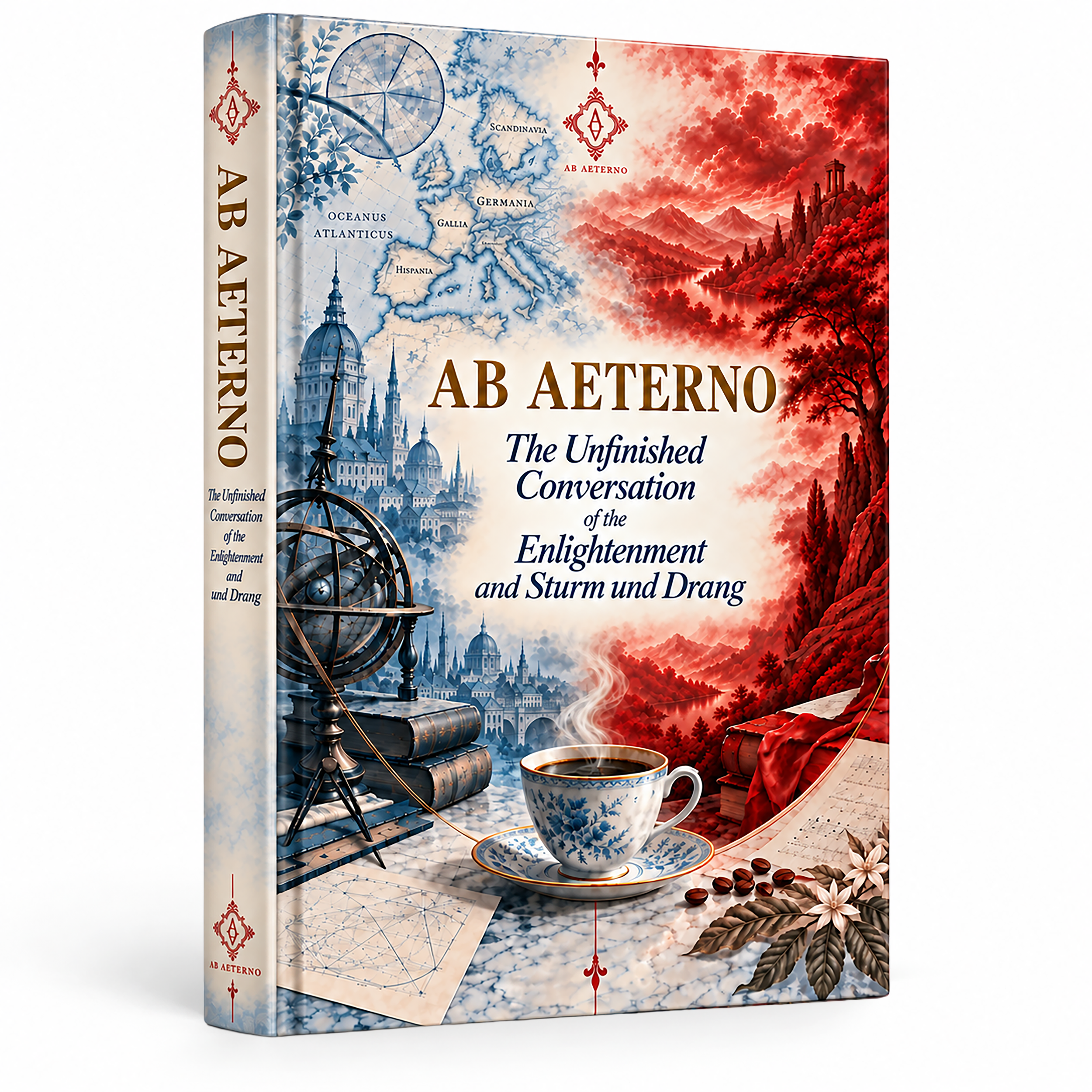
AB AETERNO
The Unfinished Conversation of the Enlightenment and Sturm und DrangUnderstand what happened.
Examine the unfinished conversation between reason and feeling, how Enlightenment ideals were appropriated, and how the resulting divisions continue to influence education, institutions, technology, and artificial intelligence.
THE BRIDGE BETWEEN THINKING AND FEELING
Change what the next generation inherits.
Give children the intellectual and emotional foundations to question inherited divisions, think independently, recognise their own humanity, and build beyond what previous generations accomplished.
