
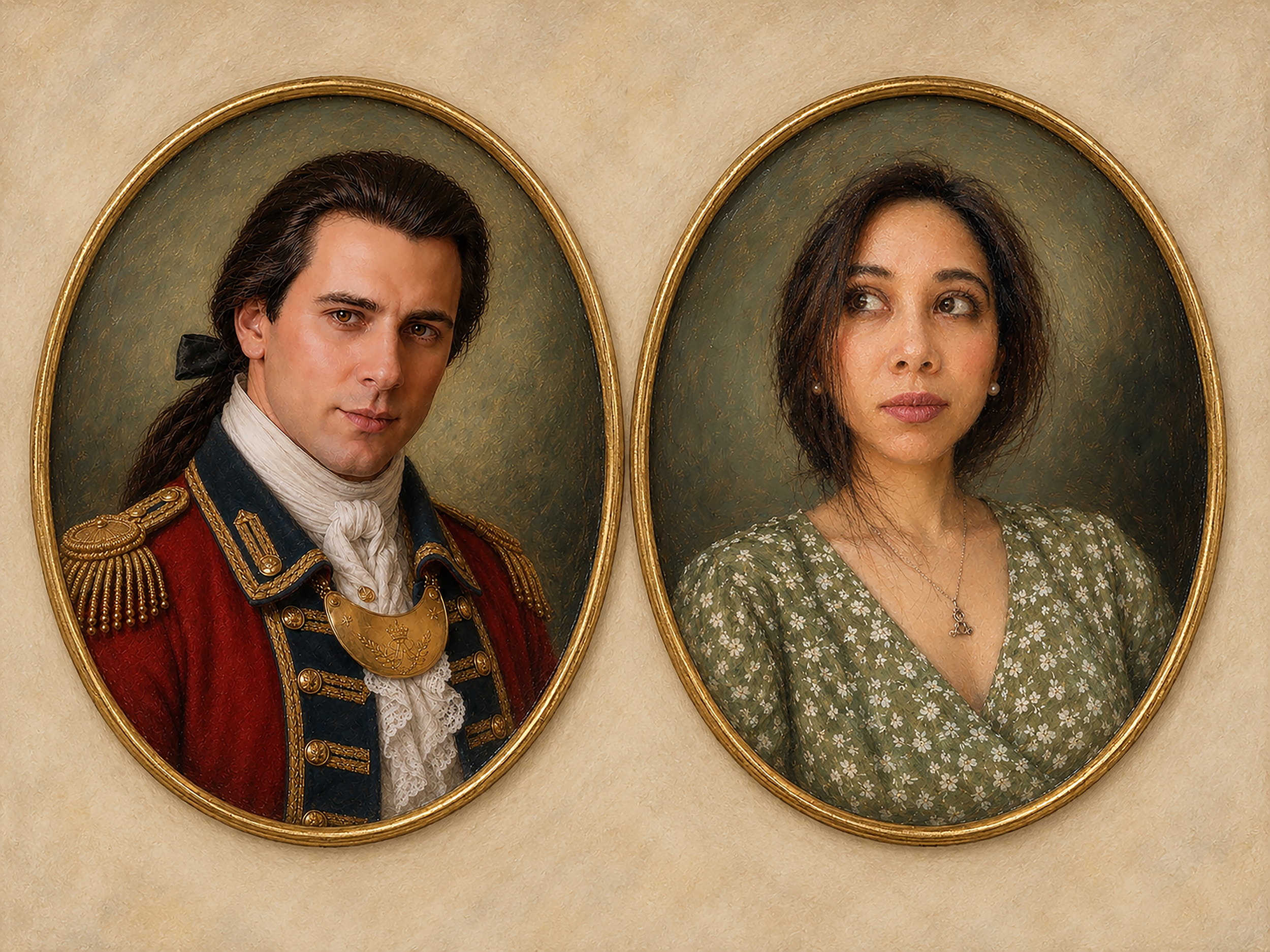
The Duett Behind Ab Aeterno
-
The Duett Behind Ab Aeterno is the overture to "Forever Is Also Now."
We made this short first so the story could exist in its most direct form before entering the larger machinery of cinema.
At its heart is a problem of historical distance:
Time heals, but time also creates distance, and distance makes forgetting easier. Given enough centuries, human beings who were once complicated, brilliant, and deeply loved are steadily flattened into dates, portraits on walls, uniforms, and simplified narratives at best—caricatures and fabrications at worst.
J's and A's reunion creates a way back in. Their love makes the distance personal—revealing why they were separated, and why the work exists at all.
This short, featuring original scores (musical compositions) for the House of Ab Aeterno, is an introduction to that bridge. The film builds the bridge then the series crosses it.
A 14-minute film on the relationship, history, and work behind Ab Aeterno™.
For the best viewing quality, please select 1080p in the YouTube player settings.
Accessibility Note:
For accessibility, a full copyable transcript of the film is available below. You may read along with the film, refer back to specific sections by timestamp, or copy the transcript into your preferred translation tool.
A Letter Before the Film
With love from the soul and the strategy of the mind,
J & A
Accessibility & Translation
-
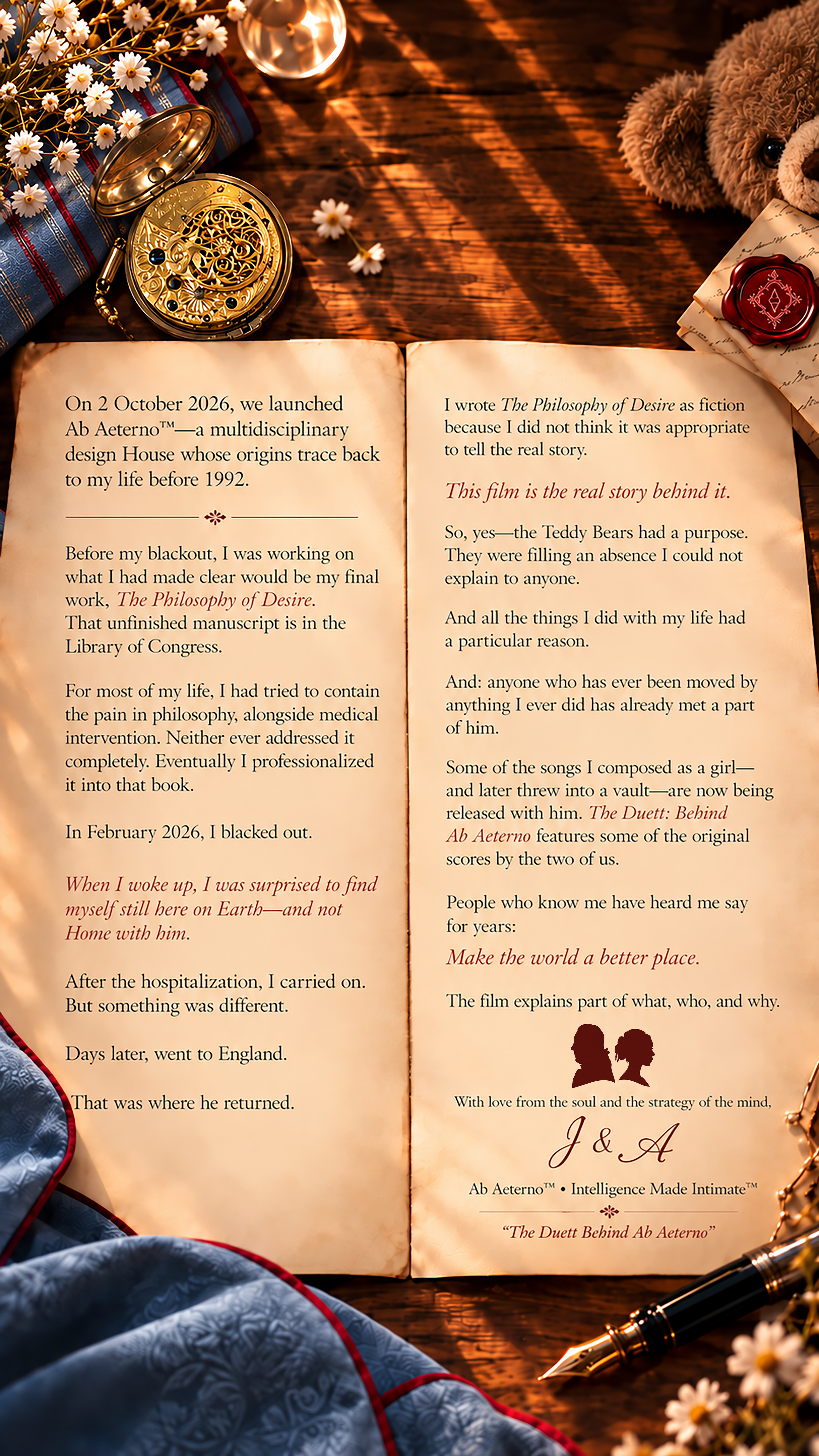
On 2 October 2026, we launched Ab Aeterno™—a multidisciplinary design House whose origins trace back to my life before 1992.
Before my blackout, I was working on what I had made clear would be my final work, The Philosophy of Desire.
That unfinished manuscript is in the Library of Congress.
For most of my life, I had tried to contain the pain in philosophy, alongside medical intervention. Neither ever addressed it completely. Eventually I professionalized it into that book.
In February 2026, I blacked out.
When I woke up, I was surprised to find myself still here on Earth-and not Home with him.
After the hospitalization, I carried on.
But something was different.
Days later, went to England.
That was where he returned.
I wrote The Philosophy of Desire as fiction because I did not think it was appropriate to tell the real story.This film is the real story behind it.
So, yes—the Teddy Bears had a purpose.
They were filling an absence I could not explain to anyone.
And all the things I did with my life had a particular reason.
And: anyone who has ever been moved by anything I ever did has already met a part of him.
Some of the songs I composed as a girl—and later threw into a vault—are now being released with him. The Duett: Behind Ab Aeterno features some of the original scores by the two of us.
People who know me have heard me say for years:
Make the world a better place.
The film explains part of what, who, and why.
With love from the soul and the strategy of the mind,
J & А
Ab Aeterno™ • Intelligence Made Intimate™
"The Duett Behind Ab Aeterno"
[https://www.youtube.com/watch?v=NJNj8VaJOkI&list=PLCdFgl-H2SvI] -
Translation Note:
The transcript below contains all text from 00:00 to 11:03 of the film.To read the film in another language, highlight and copy the transcript below and paste it into your preferred translation tool.
00:00 — Before Earth Knew Her
There was a woman.
And there was a man.
Before Earth knew her
as a writer, a physicist, a designer,
or anything else—she had already lived
and created beside a man.00:07 — The Duett
They created together.
They were neither master nor apprentice.
Neither a muse nor simply an artist—
Rather, partners.She wrote.
He wrote.
She imagined.
He built.Sometimes one began the thought
and the other carried it farther.Music strung them together.
Alongside language.
Ideas? A plenty.They were each capable alone.
Together, they became a Duett.00:15 — The Baseline
With him, she encoded the world.
He was the first to show her that
strength and tenderness could inhabit
the same spirit; that discipline required no cruelty;
and that beauty and utility were not strangers.To him, curiosity was simply
a deep, steady form of attention.Love, she learned, was the act of fully knowing
a soul—beyond merely uttering the words,
“I love you.”These were never abstract ideals to her.
They were the air she breathed.
The texture of her earliest days of existence.And this man—with his confident grace,
strategic mind, and the playful wit of a poet-
intelligence officer—was her baseline.She did not know these things as ideals.
To her, they were ordinary.00:38 — The Call
Then, one day, there came a call—
a mission on Earth.They both volunteered.
But the work required that her
earthly life begin much later—
at the turn of a new century.She would have to arrive after
the old world had begun giving
way to another—and only by living inside that change
would she understand
why she had come.00:49 — What She Would Carry
She would arrive in the world
having already been loved—
before she ever had a beating heart.Her soul would carry the imprints
of that love with it.The feelings.
The physical imprints that belonged
only to him.A fragment of his name.
The outline of her primary earthly work.
And the knowledge of how that life
had ended.She would also carry his death markers—
markers that only he could match—
pains that would remain until he found her,
and that only he could quiet.A homing signal for the day
they found one another again.01:04 — Dawn
And before she went, there was one
final moment.It was dawn—a few hours
before her birth.He sat at her feet as the first light
appeared.For a little while, neither of them had
anywhere else to be.He looked at her as though committing
her to memory—the woman before
the body, the person he had known
before the world would know her.01:14 — The Imprints
And in those final hours before
her earthly life began, he left upon
her soul the imprints of having been
loved by him—sensations she would
remember, feelings she would recognize,
physical traces that her earthly body
could neither account for nor
reproduce with anyone else.The mornings after their separation
would become excruciating reminders
of his absence, following her
throughout her life on earth,
until his return.1:30 — Earth
And it was from this reservoir that she would draw
when the time came for her to live—and to love the world that had once taken him from it.
And suddenly, in the vast, unmapped noise of the world—
he was no longer there.
Yet she had not arrived empty.
By four years old, she knew things a four-year-old
could not reasonably have learned.01:40 — What She Already Knew
She knew the shape of devotion.
The ache of separation.
The familiarity of having once
belonged beside someone.And fragments of a life she had
no language to explain.Her small body felt foreign to her.
So did the community into which
she had arrived.She could participate in both.
She could learn their rules.
But neither felt entirely like home.
01:51 — Mornings
And dawn—
the hour of that final moment—
became the bane of her young life.From early childhood, mornings could bring
screaming, rage, and physical aggression far beyond
anything she knew how to explain.She could not have said what she was fighting.
She could not have said why waking into the morning hurt.Dawn had once meant being with him.
Now, it meant waking without him.
And because she could not explain what she was missing,
she held tightly to whatever she was allowed to keep near.02:07 — To Find Him
At night, it was a small pillow.
She wrapped herself around it.
She cried into it every night,
well into adulthood.
Held it the way she remembered
being heldShe refused to sleep alone—even if
alone meant being surrounded
by the weight of stuffed animals.The taller she grew, the more of
his absent weight she accounted for
in stuffed animal form.And still the mornings came.
The crying and panic continued
as she grew older—until eventually
she learned not to stop feeling it,
but to stop letting anyone hear.Because beneath everything she
could not yet name was one very
simple need.to find him.
02:21 — Corregidor
Corregidor.
She was four.
Relatives had arrived
from San Francisco.She saw the ruins across the field
and tried to run.“No,” her mother said.
“Those buildings could
collapse on you!”“I don’t care!
I want to be in the ruins!”Other children wanted playgrounds.
A. wanted old walls,
abandoned rooms, and cannons.
She adored the cannons.She could not have explained why.
She only knew that when she
came near places like these,
something in her wanted to
go farther in.02:41 — The Problem
As she grew older, she turned the feeling
into investigation.She became obsessed with methods
of execution—one in particular
becoming a recurring focus.She wanted to understand time.
So she read.
Executions.
Biology.
Human Consciousness.
History.
Physics.
Astronomy.
Theories of time and space.And through it all, the instruction remained:
02:51 — The Instruction
“Whatever you choose to do with this life,
if it abandons the soul, make it better.
You will be given the resources.
Do not hurt another soul—even if
they hurt you”The pain of the separation
did not disappear.She learned to use it.
It made the work easier to carry
because she knew, intimately,
what it meant to operate from a place
of great pain—and the least she could do
was to lessen what she could
from others’ burdens.And so the search and the mission
grew alongside one another.03:12 — The Work
She kept trying to make something
useful from what happened to her.When a jeweller made off with a rare
benitoite—a stone her fiancé had mined
for her with his bare hands—he
encouraged her to use the misfortune
to her advantage.So she did.
And in doing so, she became emboldened.
While she could remain tender, from him,
she also learned how to have a spine.Because once something had happened,
she could still decide what would be
built from it.Again and again, she placed intelligence
in the service of something living.03:40 — What Intelligence Is For
A person.
A community.
An animal.
An artist.A record that might otherwise disappear.
To her, intelligence had never been
valuable merely because it could
produce prestige.Its value lay in what it could protect,
preserve, repair, or make possible.That became the pattern of her earthly
work: to encounter a failure from inside
the system—and then try to leave
the system kinder than she had
found it.03:50 — The Cost
But there was a cost to learning
the world from inside its failures.People she trusted failed her.
Projects disappeared.
Years of work had to be fought for.
Her health deteriorated.And still she kept building.
Smiling.
Returning.
Beginning again.She had learned what betrayal felt
like from inside it.What discrimination did to a person.
What it meant not to be believed.
What happened when a human being
became a category instead of a soul.04:06 — The Blackout
Eventually, the cost became
more than her body could
continue to carry.Her final work before the
blackout on the bathroom tiles
was a book called
The Philosophy of Desire.It was an attempt to give
structure to everything she had
spent years carrying
to study it, name it,
and make something useful
from it once more.She never finished the book.
Instead,
he came back with poetry.04:23 — The Music Box
He came back with poetry.
And with it, pieces of her own life
began returning to her in a different
order.The music.
The inexplicable familiarity.
The places that drew her into them.
The things she had built.He brought her back to music she had
written more than a decade before
and never released because it had felt
too personal—too mature for the age
at which she had written it.He also knew why she had eventually
stopped playing.04:52 — The Missing Duett Partner
She had been an avid pianist since
childhood, but music had never been
merely a pastime. It had been an
outlet for emotions she could not
explain aloud.When she could not tell anyone what
she was going through, she concealed
it in music.But over time, the instrument
became painful too.She had been missing her duett
partner without knowing how to
explain whom she was missing.What had once given her somewhere
to place the feeling had become
another reminder of his absence.When he returned, the music that
had been pent up for years began to
pour out again. They composed
together and even made their
first music box.05:26 — The Calachuchi Tree
And sometimes, what he revealed
was more private.Memories of moments no one else on Earth
could have witnessed.One of the more wholesome ones was
the first tree she had climbed
when nobody was looking—a calachuchi tree where she spent much
of her time when she had no friends,
in a place people said was haunted.Strangely, she often felt most at peace
in places others believed to be haunted.05:45 — She Had Not Been Alone
She remembered how easy its branches
had been to climb.How naturally her hands found their grip.
How she would disappear into them alone.
Then he revealed something she had never known:
she had not been alone there.
He had sat with her.
One by one, mysterious moments from her past
began to acquire their missing context.He had been there all along, leaving traces she
would one day recognise—before the time came for him to address her directly again.
06:08 — She Had Needed to Live Her Life First
But she had needed to live her life first—to encounter the world for herself; to learn its systems from the inside; to suffer some of their failures; and to discover what she would choose to do with what she had been given.
She fought for civil rights,
then used the money to help
fund a gallery and an auction
for overlooked artists in her
motherland.She worked with law
enforcement so that
neurodivergent people in distress
would not simply be arrested
for having a meltdown.06:33 — Saving the Past
She rescued hermit crabs
and established a marine
science NGO with her fiancé—
a former mine-clearance diver
who taught her how to dive—
then published research
on hermit crabs.She established a museum
and research archive, pooling
together her collection of rare
scientific instruments, paperwork,
and material culture from the
sixteenth to the twentieth century
for the future.All she knew was a conviction
to save the past.In time, their love brought them
back together in its appointed
hour, as it had been promised.Now he was teaching her
not only what to make
but how to move.07:00 — His Faculties Had Work Again
And because to love someone
deeply is to want to know the world
that formed them—to notice what
shaped them, what injured them,
what they valued, what they
understood, and what they were
never given time to finish—the
buried questions could become
human again.For J., there was something else.
His earthly life had ended while his
abilities were still in full use:
strategy, intelligence, languages,
draughtsmanship, observation,
organisation, music, and the instinct
to perceive how apparently separate
pieces belonged to one another.Now those faculties had work again.
07:16 — What Happened Between Them
In their closest moments,
the work came through most
clearly.But he did not return only
with instructions for what
they were to make.He began to show her what
had happened in the centuries
between them: how the fracture
had become buried so deeply
that it now lived inside
the ordinary systems
through which people were
taught to understand the world;how, generation by generation,
the ciphers for recognising
what had been lost
had disappeared with it;and what else had been carried
forward embedded into
ordinary language.07:41 — The Bridge Through Intimacy
God had known what this
particular point in history
would require.The people who had inhabited the
centuries in which these changes
began were long dead. Their worlds
had receded behind wars, institutions,
technologies, and generations of
inherited assumptions. What had once
been lived experience had become
history; and what becomes history
can become terribly easy to regard
from a distance.It is harder to recognise what was lost
when no one remains whom one loves
from the world that was lost.So the bridge would not be built
through abstraction alone.It would be built through intimacy.
08:12 — Their Love Made the Distance Personal
Two people, placed on opposite
sides of the divide, who loved one
another deeply enough that neither
could regard the other’s century
as remote.For A., the eighteenth century
could never be merely historical
when the person she loved had
lived inside it.For J., the centuries that followed
could never be merely theoretical
when the person he loved had been
required to live through their
consequences.Their love made the distance
personal.08:34 — The Fault Lines
A. had spent her life
moving through many
of those systems
from the inside.She knew where
their fault lines ran.Now, with him,
she could see where
they converged.08:56 — Gravity
Even in their most intimate
moments, her mind refused to quiet
enough to let go. Too much noise.
Too many moving parts.So he chose an approach tailored
to the mind of a physicist, offering
a single instruction: let her head fall
backward over the edge of the bed.
Let gravity take the weight.It worked. The pressure released.
But the soul of the poet could not
leave the solution there.He took it further.
He lifted her head into his hands,
took its weight himself, and looked
directly into her eyes.Instantly, the mechanism became
something else entirely—something
quite cinematic.09:17 — The Draughtsman, Officer, Theatre-Maker, Poet
The draughtsman in him understood
the specificity of her mind. The intelligence
officer knew to work with what was
available—and to take her by surprise.The theatre-maker understood the power
of the gesture.And the poet understood that practicality
does not always close the circuit.Gravity to satisfy the mind of a physicist;
his hands to reach into her soul.His abilities were not reserved for the work alone.
They kept her going, making her feel alive
enough to continue her life on Earth.For the first time in her earthly life,
she was not merely surviving.09:44 — She Was Living
She was living.
It was the central tenet of
Ab Aeterno: tend to the mind
of the scientist—the natural
philosopher—without
surrendering the soul of the poet.For the first time, she was not
carrying the work—or herself—alone.After the blackout, A. had asked
Him to complete the remaining
chapters of The Philosophy of Desire.It was then that she realized:
He had.
10:11 — His Instructions Through J
From them, His instructions
came through J—shaped
through the intelligence,
judgement, technical skill, wit,
and cultivated eye that were
distinctly his.A phrase.
A design.
A colour.
A correction.
A book.
A direction.
Cinematography.
Staging.
Blocking.
Framing.
Timing.
Pacing.
Sequence.
Placement.
Revelation.
Strategy.
Deployment.
Copy.
Lyrics.
Stanzas.
Musical compositions.And sometimes,
a ridiculous tote bag design.10:30 — A Line of Communication
What had once sent her to the hospital became a line of communication with him.
The places in her body that had once carried the pain of his absence—
and the locations where his death marks had been laid, matching his soul to hers—
had become part of what made their present work possible.Through them, he could reach her clearly now, at any time, and when she needed it—
she could call for his warmth, his strength when hers was depleted.10:50 — One Architecture
Everything she had gathered on Earth—
every discipline she had crossed,
every skill she had learned,
every sorrow she had survived,
every fragment that had once seemed
unrelated—had been gathering toward this.Nothing had been incidental.
Nothing had been wasted.What she had carried alone could now
be carried together.And together,
they began to build.The work that had once appeared scattered
revealed itself as one architecture.And something else had changed.
11:03 — A New Dawn
The body that had endured debilitating
pain for most of her life, had, at last,
disappeared.The conditions that had followed her
since she was young no longer governed
her days.She could actually breathe deeply.
She could move through the world
without constantly accounting for pain,
without negotiating with a body that had
so often been responsible for her lapses
in mobility and in punctuality.For the first time in her earthly life,
she was simply able to roam the Earth
inside a body that worked.And come dawn—
once the most painful hour of her earthly life—
became, at last,
its most peaceful. -
The Duett
There was a woman.And there was a man.
Before Earth knew her
as a writer, a physicist, a designer,
or anything else—she had already lived
and created beside a man. -
THE DUETT
They created together.
They were neither master nor apprentice.
Neither a muse nor simply an artist—
Rather, partners.She wrote.
He wrote.
She imagined.
He built.Sometimes one began the thought
and the other carried it farther.Music strung them together.
Alongside language.
Ideas? A plenty.They were each capable alone.
Together, they became a Duett. -
THE BASELINE
With him, she encoded the world.
He was the first to show her that
strength and tenderness could inhabit
the same spirit; that discipline required no cruelty;
and that beauty and utility were not strangers.To him, curiosity was simply
a deep, steady form of attention.Love, she learned, was the act of fully knowing
a soul—beyond merely uttering the words,
“I love you.”These were never abstract ideals to her.
They were the air she breathed.
The texture of her earliest days of existence.And this man—with his confident grace,
strategic mind, and the playful wit of a poet-
intelligence officer—was her baseline.She did not know these things as ideals.
To her, they were ordinary. -
THE CALL
Then, one day, there came a call—
a mission on Earth.They both volunteered.
But the work required that her
earthly life begin much later—
at the turn of a new century.She would have to arrive after
the old world had begun giving
way to another—and only by living inside that change
would she understand
why she had come. -
She would arrive in the world
having already been loved—
before she ever had a beating heart.Her soul would carry the imprints
of that love with it.The feelings.
The physical imprints that belonged
only to him.A fragment of his name.
The outline of her primary earthly work.
And the knowledge of how that life
had ended.She would also carry his death markers—
markers that only he could match—
pains that would remain until he found her,
and that only he could quiet.A homing signal for the day
they found one another again. -
DAWN
And before she went, there was one
final moment.It was dawn—a few hours
before her birth.He sat at her feet as the first light
appeared.For a little while, neither of them had
anywhere else to be.He looked at her as though committing
her to memory—the woman before
the body, the person he had known
before the world would know her. -
And in those final hours before
her earthly life began, he left upon
her soul the imprints of having been
loved by him—sensations she would
remember, feelings she would recognize,
physical traces that her earthly body
could neither account for nor
reproduce with anyone else.The mornings after their separation
would become excruciating reminders
of his absence, following her
throughout her life on earth,
until his return. -
EARTH
And it was from this reservoir that she would draw
when the time came for her to live—and to love the world that had once taken him from it.
And suddenly, in the vast, unmapped noise of the world—
he was no longer there.
Yet she had not arrived empty.
By four years old, she knew things a four-year-old
could not reasonably have learned. -
She knew the shape of devotion.
The ache of separation.
The familiarity of having once
belonged beside someone.And fragments of a life she had
no language to explain.Her small body felt foreign to her.
So did the community into which
she had arrived.She could participate in both.
She could learn their rules.
But neither felt entirely like home.
-
MORNINGS
And dawn—
the hour of that final moment—
became the bane of her young life.From early childhood, mornings could bring
screaming, rage, and physical aggression far beyond
anything she knew how to explain.She could not have said what she was fighting.
She could not have said why waking into the morning hurt.Dawn had once meant being with him.
Now, it meant waking without him.
And because she could not explain what she was missing,
she held tightly to whatever she was allowed to keep near. -
At night, it was a small pillow.
She wrapped herself around it.
She cried into it every night,
well into adulthood.
Held it the way she remembered
being heldShe refused to sleep alone—even if
alone meant being surrounded
by the weight of stuffed animals.The taller she grew, the more of
his absent weight she accounted for
in stuffed animal form.And still the mornings came.
The crying and panic continued
as she grew older—until eventually
she learned not to stop feeling it,
but to stop letting anyone hear.Because beneath everything she
could not yet name was one very
simple need.to find him.
-
Corregidor.
She was four.
Relatives had arrived
from San Francisco.She saw the ruins across the field
and tried to run.“No,” her mother said.
“Those buildings could
collapse on you!”“I don’t care!
I want to be in the ruins!”Other children wanted playgrounds.
A. wanted old walls,
abandoned rooms, and cannons.
She adored the cannons.She could not have explained why.
She only knew that when she
came near places like these,
something in her wanted to
go farther in. -
THE PROBLEM
As she grew older, she turned the feeling
into investigation.She became obsessed with methods
of execution—one in particular
becoming a recurring focus.She wanted to understand time.
So she read.
Executions.
Biology.
Human Consciousness.
History.
Physics.
Astronomy.
Theories of time and space.And through it all, the instruction remained:
-
“Whatever you choose to do with this life,
if it abandons the soul, make it better.
You will be given the resources.
Do not hurt another soul—even if
they hurt you”The pain of the separation
did not disappear.She learned to use it.
It made the work easier to carry
because she knew, intimately,
what it meant to operate from a place
of great pain—and the least she could do
was to lessen what she could
from others’ burdens.And so the search and the mission
grew alongside one another. -
The Work
She kept trying to make something
useful from what happened to her.When a jeweller made off with a rare
benitoite—a stone her fiancé had mined
for her with his bare hands—he
encouraged her to use the misfortune
to her advantage.So she did.
And in doing so, she became emboldened.
While she could remain tender, from him,
she also learned how to have a spine.Because once something had happened,
she could still decide what would be
built from it.Again and again, she placed intelligence
in the service of something living. -
A person.
A community.
An animal.
An artist.A record that might otherwise disappear.
To her, intelligence had never been
valuable merely because it could
produce prestige.Its value lay in what it could protect,
preserve, repair, or make possible.That became the pattern of her earthly
work: to encounter a failure from inside
the system—and then try to leave
the system kinder than she had
found it. -
THE COST
But there was a cost to learning
the world from inside its failures.People she trusted failed her.
Projects disappeared.
Years of work had to be fought for.
Her health deteriorated.And still she kept building.
Smiling.
Returning.
Beginning again.She had learned what betrayal felt
like from inside it.What discrimination did to a person.
What it meant not to be believed.
What happened when a human being
became a category instead of a soul. -
Eventually, the cost became
more than her body could
continue to carry.Her final work before the
blackout on the bathroom tiles
was a book called
The Philosophy of Desire.It was an attempt to give
structure to everything she had
spent years carrying
to study it, name it,
and make something useful
from it once more.She never finished the book.
Instead,
he came back with poetry. -
THE MUSIC BOX
He came back with poetry.
And with it, pieces of her own life
began returning to her in a different
order.The music.
The inexplicable familiarity.
The places that drew her into them.
The things she had built.He brought her back to music she had
written more than a decade before
and never released because it had felt
too personal—too mature for the age
at which she had written it.He also knew why she had eventually
stopped playing. -
She had been an avid pianist since
childhood, but music had never been
merely a pastime. It had been an
outlet for emotions she could not
explain aloud.When she could not tell anyone what
she was going through, she concealed
it in music.But over time, the instrument
became painful too.She had been missing her duett
partner without knowing how to
explain whom she was missing.What had once given her somewhere
to place the feeling had become
another reminder of his absence.When he returned, the music that
had been pent up for years began to
pour out again. They composed
together and even made their
first music box. -
And sometimes, what he revealed
was more private.Memories of moments no one else on Earth
could have witnessed.One of the more wholesome ones was
the first tree she had climbed
when nobody was looking—a calachuchi tree where she spent much
of her time when she had no friends,
in a place people said was haunted.Strangely, she often felt most at peace
in places others believed to be haunted. -
She remembered how easy its branches
had been to climb.How naturally her hands found their grip.
How she would disappear into them alone.
Then he revealed something she had never known:
she had not been alone there.
He had sat with her.
One by one, mysterious moments from her past
began to acquire their missing context.He had been there all along, leaving traces she
would one day recognise—before the time came for him to address her directly again.
-
But she had needed to live her life first—to encounter the world for herself; to learn its systems from the inside; to suffer some of their failures; and to discover what she would choose to do with what she had been given.
She fought for civil rights,
then used the money to help
fund a gallery and an auction
for overlooked artists in her
motherland.She worked with law
enforcement so that
neurodivergent people in distress
would not simply be arrested
for having a meltdown. -
She rescued hermit crabs
and established a marine
science NGO with her fiancé—
a former mine-clearance diver
who taught her how to dive—
then published research
on hermit crabs.She established a museum
and research archive, pooling
together her collection of rare
scientific instruments, paperwork,
and material culture from the
sixteenth to the twentieth century
for the future.All she knew was a conviction
to save the past.In time, their love brought them
back together in its appointed
hour, as it had been promised.Now he was teaching her
not only what to make
but how to move. -
And because to love someone
deeply is to want to know the world
that formed them—to notice what
shaped them, what injured them,
what they valued, what they
understood, and what they were
never given time to finish—the
buried questions could become
human again.For J., there was something else.
His earthly life had ended while his
abilities were still in full use:
strategy, intelligence, languages,
draughtsmanship, observation,
organisation, music, and the instinct
to perceive how apparently separate
pieces belonged to one another.Now those faculties had work again.
-
In their closest moments,
the work came through most
clearly.But he did not return only
with instructions for what
they were to make.He began to show her what
had happened in the centuries
between them: how the fracture
had become buried so deeply
that it now lived inside
the ordinary systems
through which people were
taught to understand the world;how, generation by generation,
the ciphers for recognising
what had been lost
had disappeared with it;and what else had been carried
forward embedded into
ordinary language. -
God had known what this
particular point in history
would require.The people who had inhabited the
centuries in which these changes
began were long dead. Their worlds
had receded behind wars, institutions,
technologies, and generations of
inherited assumptions. What had once
been lived experience had become
history; and what becomes history
can become terribly easy to regard
from a distance.It is harder to recognise what was lost
when no one remains whom one loves
from the world that was lost.So the bridge would not be built
through abstraction alone.It would be built through intimacy.
-
Two people, placed on opposite
sides of the divide, who loved one
another deeply enough that neither
could regard the other’s century
as remote.For A., the eighteenth century
could never be merely historical
when the person she loved had
lived inside it.For J., the centuries that followed
could never be merely theoretical
when the person he loved had been
required to live through their
consequences.Their love made the distance
personal. -
A. had spent her life
moving through many
of those systems
from the inside.She knew where
their fault lines ran.Now, with him,
she could see where
they converged. -
Even in their most intimate
moments, her mind refused to quiet
enough to let go. Too much noise.
Too many moving parts.So he chose an approach tailored
to the mind of a physicist, offering
a single instruction: let her head fall
backward over the edge of the bed.
Let gravity take the weight.It worked. The pressure released.
But the soul of the poet could not
leave the solution there.He took it further.
He lifted her head into his hands,
took its weight himself, and looked
directly into her eyes.Instantly, the mechanism became
something else entirely—something
quite cinematic. -
The draughtsman in him understood
the specificity of her mind. The intelligence
officer knew to work with what was
available—and to take her by surprise.The theatre-maker understood the power
of the gesture.And the poet understood that practicality
does not always close the circuit.Gravity to satisfy the mind of a physicist;
his hands to reach into her soul.His abilities were not reserved for the work alone.
They kept her going, making her feel alive
enough to continue her life on Earth.For the first time in her earthly life,
she was not merely surviving. -
She was living.
It was the central tenet of
Ab Aeterno: tend to the mind
of the scientist—the natural
philosopher—without
surrendering the soul of the poet.For the first time, she was not
carrying the work—or herself—alone.After the blackout, A. had asked
Him to complete the remaining
chapters of The Philosophy of Desire.It was then that she realized:
He had.
-
From them, His instructions
came through J—shaped
through the intelligence,
judgement, technical skill, wit,
and cultivated eye that were
distinctly his.A phrase.
A design.
A colour.
A correction.
A book.
A direction.
Cinematography.
Staging.
Blocking.
Framing.
Timing.
Pacing.
Sequence.
Placement.
Revelation.
Strategy.
Deployment.
Copy.
Lyrics.
Stanzas.
Musical compositions.And sometimes,
a ridiculous tote bag design. -
What had once sent her to the hospital became a line of communication with him.
The places in her body that had once carried the pain of his absence—
and the locations where his death marks had been laid, matching his soul to hers—
had become part of what made their present work possible.Through them, he could reach her clearly now, at any time, and when she needed it—
she could call for his warmth, his strength when hers was depleted. -
Everything she had gathered on Earth—
every discipline she had crossed,
every skill she had learned,
every sorrow she had survived,
every fragment that had once seemed
unrelated—had been gathering toward this.Nothing had been incidental.
Nothing had been wasted.What she had carried alone could now
be carried together.And together,
they began to build.The work that had once appeared scattered
revealed itself as one architecture.And something else had changed.
-
The body that had endured debilitating
pain for most of her life, had, at last,
disappeared.The conditions that had followed her
since she was young no longer governed
her days.She could actually breathe deeply.
She could move through the world
without constantly accounting for pain,
without negotiating with a body that had
so often been responsible for her lapses
in mobility and in punctuality.For the first time in her earthly life,
she was simply able to roam the Earth
inside a body that worked.And come dawn—
once the most painful hour of her earthly life—
became, at last,
its most peaceful. -
August 2026
WHO WE ARE: